


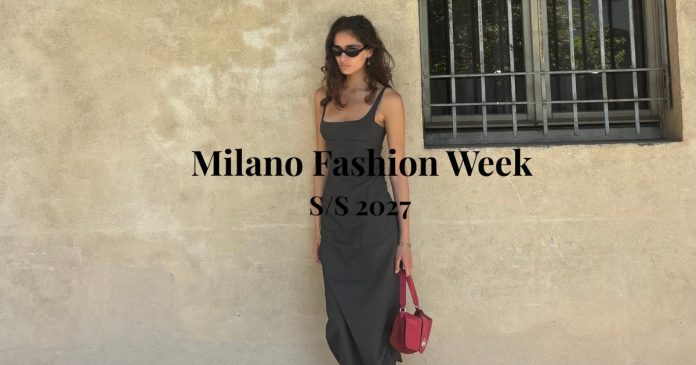
From palazzo courtyards to steel arched halls and a historic house museum, my Milan Fashion Week for City Magazine showed how differently fashion can be presented. Here are the six shows and presentations I attended, starting with the ones that mattered most.
Marques’Almeida
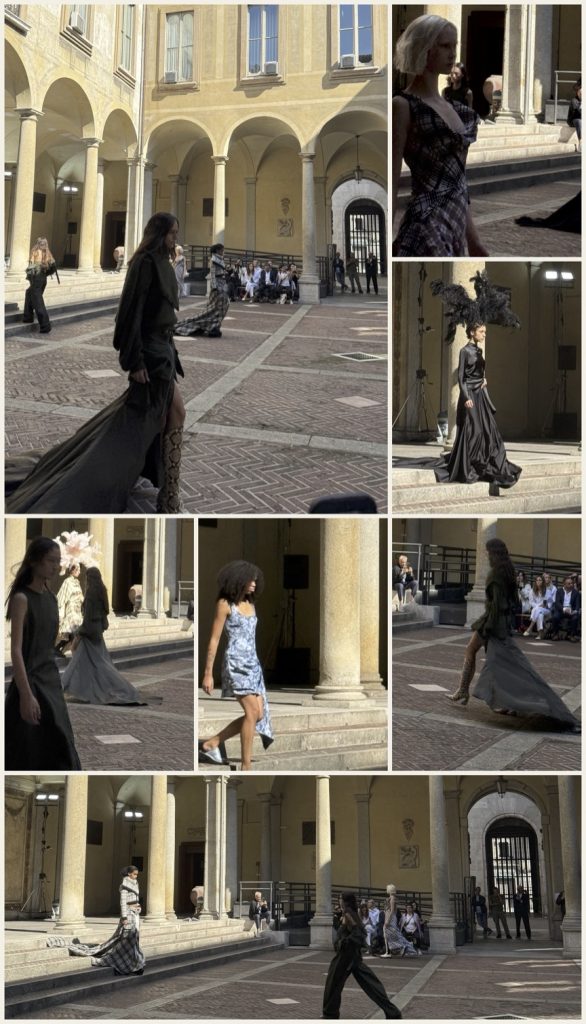
On a sunny Sunday afternoon, Marques’Almeida made its Milan debut in the arcaded courtyard of Palazzo Isimbardi. Founded in London in 2011 by Portuguese designers Marta Marques and Paulo Almeida, winners of the 2015 LVMH Prize, the label came to Milan with the support of Portugal Fashion. For Spring/Summer 2027, the duo turned their grungy roots into grown up occasion wear: long slip dresses and sweeping trains worn with snakeskin boots, asymmetric plaid, a blue floral slip dress and dramatic feather headpieces in black and blush pink. “It is not so put together,” said Marta Marques, and that undone elegance looked perfect against the classical arches.
Florania
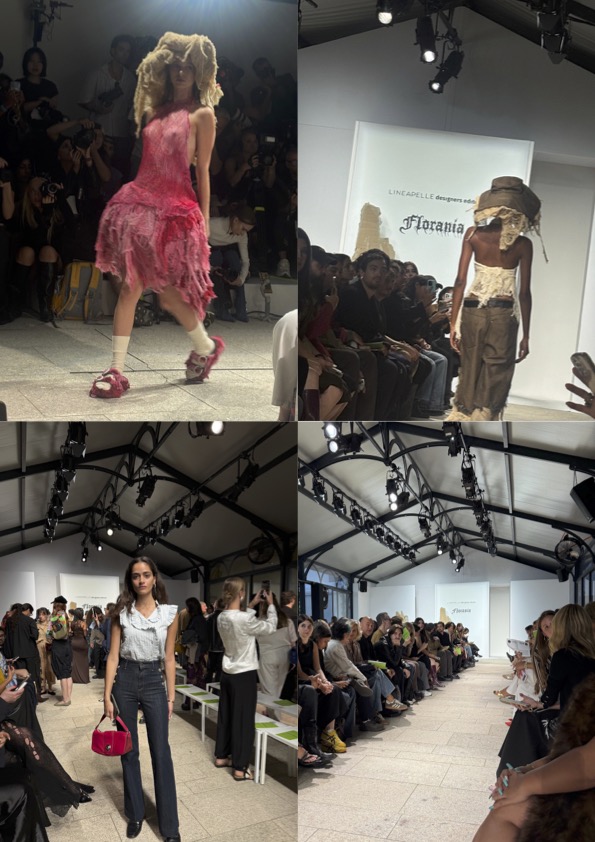
Florania presented its Spring/Summer 2027 collection as part of the LineaPelle Designers Edition, under the steel arches of LineaPelle’s Milan space. Founded by Flora Rabitti, who trained at Miu Miu, Florania is a fully circular, women led brand and won the CNMI Fashion Trust Prize in 2023. This season was inspired by a calm Italian lake caught in a storm: leather airbrushed to look weathered, knits with frayed hems like seaweed and sea foam, raw burlap hats and a coral pink dress dissolving into ragged layers. It was a reminder that sustainable fashion can be anything but quiet.
Miguel Vieira
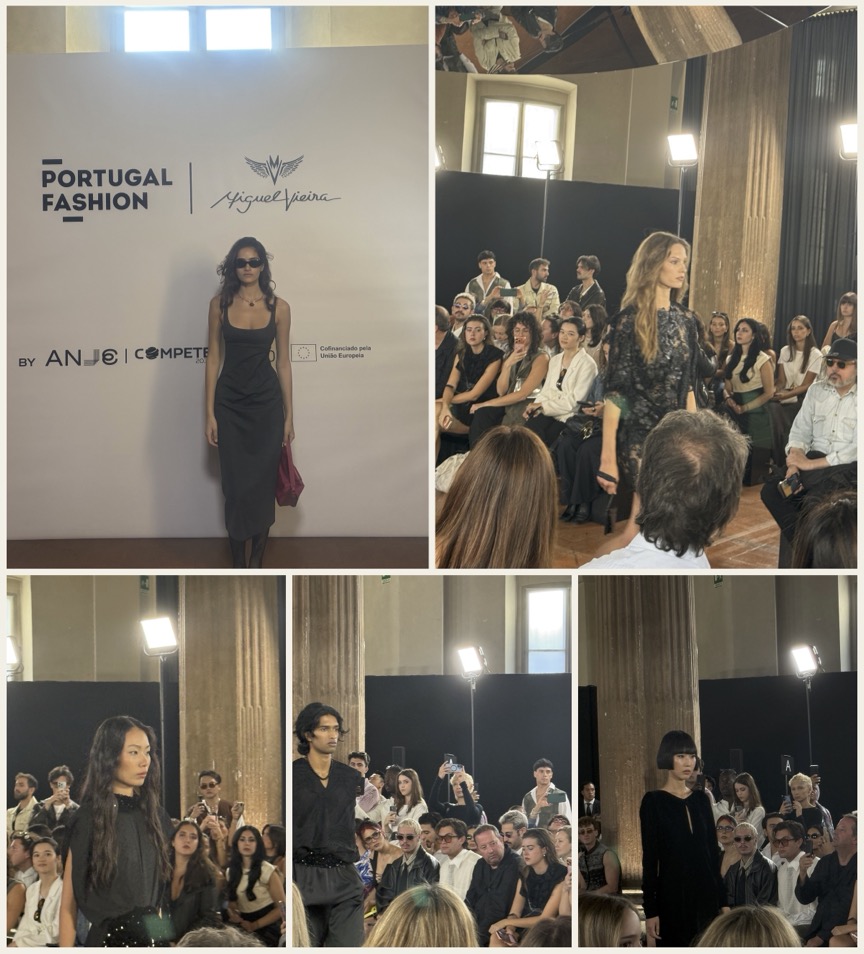
The same day, Portugal Fashion also brought Miguel Vieira to Milan. The Portuguese designer, who founded his label in the late 1980s, presented “Back To Black”, a Spring/Summer 2027 collection where black is the structure of every garment rather than just a colour. The variety came from materials: silk, fine wool, sequins, leather and sheer fabrics, cut in clean lines and finished with handcrafted flowers in fabric and leather. Long fluid dresses, keyhole necklines and beaded belts proved that black, done well, needs nothing else.
Amato Daniele
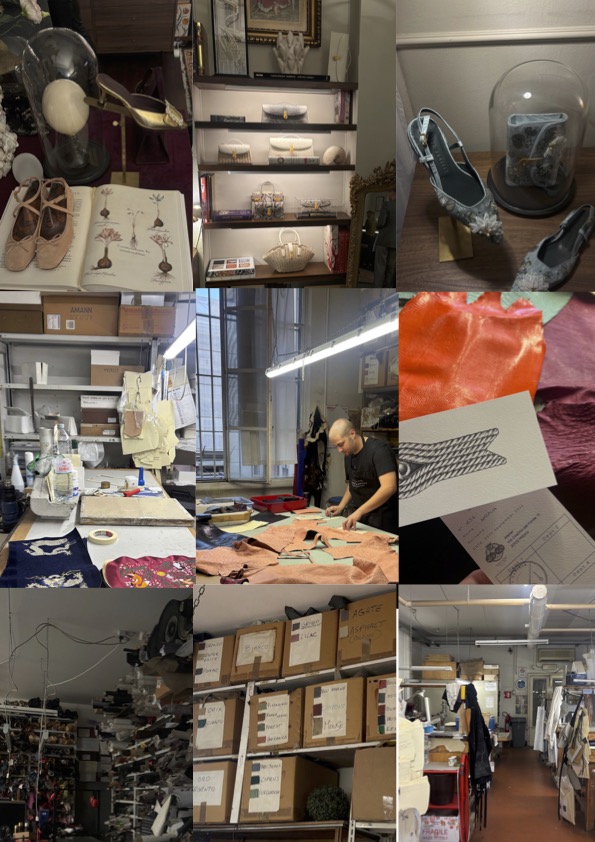
Amato Daniele opened the doors of its workshop in the centre of Milan, where bags and shoes are still made by hand. Led by Daniele Amato, the seventh generation of the Locati family, the brand carries the legacy of Leu Locati, a historic Milanese house whose clients included Grace Kelly and Princess Diana. Between the cutting tables, I watched exotic skins in coral, mint and burgundy being cut by hand, next to embroidered panels of dragons, foxes and constellations.
In the showroom, water lily slingbacks and a matching clutch sat under a glass dome: a rare look at the craft behind the object.
KASAI
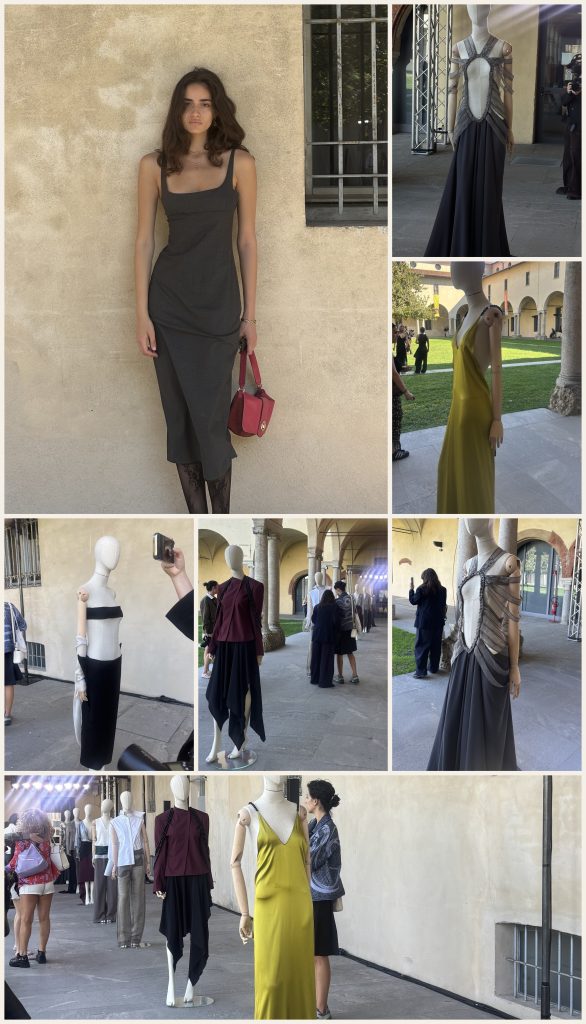
Studio Kasai skipped the runway and showed its collection on mannequins along the arcades of a sunlit cloister. The Bucharest based womenswear house makes its pieces to order, in limited quantities in Romania, exploring feminine duality: masculine tailoring seen through a feminine lens, and corsetry used as structure rather than restriction. The standouts were a grey gown with a braided cut out bodice, a liquid chartreuse slip dress and a burgundy jacket over an asymmetric handkerchief skirt.
Christopher
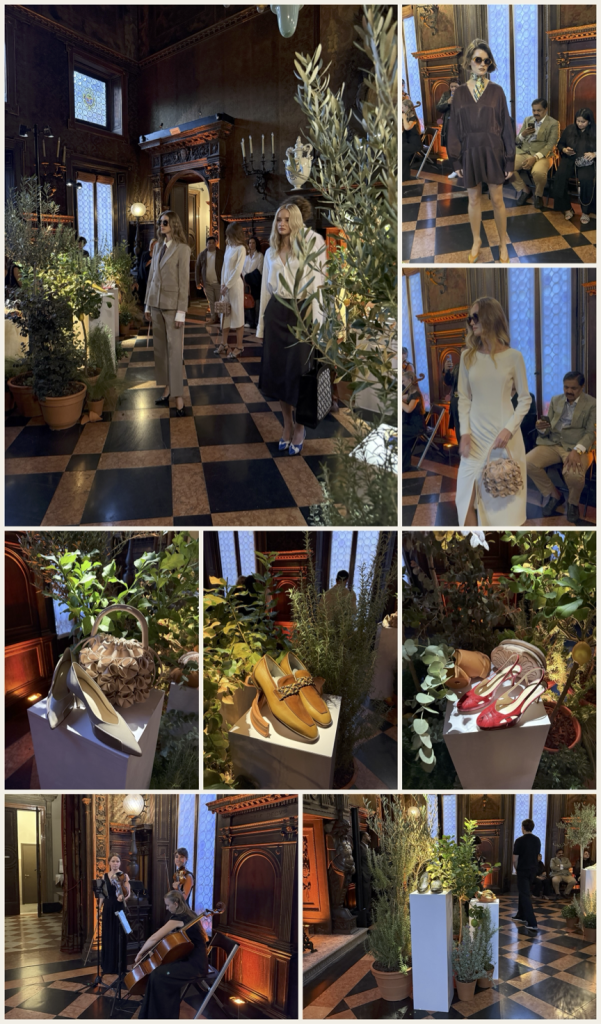
My week ended with Christopher, in the beautiful rooms of Museo Bagatti Valsecchi. The young Made in Italy house, created by the Agrawal family’s Sahakar Group, opened its first boutique on Via della Spiga in 2025. Among olive trees, rosemary and a string quartet, models in soft tailoring and ivory dresses walked between plinths displaying a nude bag covered in leather petals, caramel loafers with a woven chain and red slingbacks. It was a calm, elegant finale, true to the brand’s motto: what endures is never ordinary.
Text and Photos – Natalia Papuashvili